Interpretation places the interpreted object, the artwork, at a certain distance from reality. Beyond perception and cognition, it can be seen as the symptom of a cultural condition, even a kind of curse: a “subject” increasingly estranged from direct experience, over-intellectualized and unsettled by ambiguity, compelled to decode everything. Susan Sontag argued that the urge to interpret, to reduce art to content or to a hidden meaning, is “the revenge of the intellect upon art”: a drive that impoverishes the world in order to build a parallel world of “meanings.” Art cannot truly be reduced to any singular interpretation; the moment it can be substituted or paraphrased, it ceases to be art. In this sense art is closer to metaphor, composed not only of its subject but of the way it stages that subject. Yet even metaphor remains limiting. Art exists only insofar as it resists rational explanation, insofar as its meaning escapes us in one way or another (Danto). I have come to believe that art ultimately surpasses metaphor, becoming a dynamic, active metabolism that does not reveal itself analytically. Instead, it generates a space in which the act of knowing becomes indistinguishable from the act of being.
***
Anathema explores primordial and experiential forms of awareness, an invitation to embrace the “grit in the machine” (T. E. Hulme) and to recognize doubt as a generative metabolic force. Inverting the Cartesian establishment, where the cogito becomes the indubitable foundation for the existence of the world and the truth of science, Anathema calls for a sustained state of uncertainty that leads to a profound and disquieting experience of being. The spectator’s consciousness is invited to merge with raw, undifferentiated matter.
The design choices deliberately resist easy interpretation. Working together to dissolve conventional sensory anchors, they operate as more than aesthetic devices; they enact a cultivated strategy to induce a state of “dedifferentiation,” which I understand as a temporary suspension of rational imperatives and a restoration of unity. Anathema proposes that in the face of deep time and the reality of an indifferent cosmos, we must relinquish the illusion of absolute clarity. Noise, often treated as parasitic because it obscures or interferes with desired structures—is not an obstacle but an intrinsic necessity within the system.
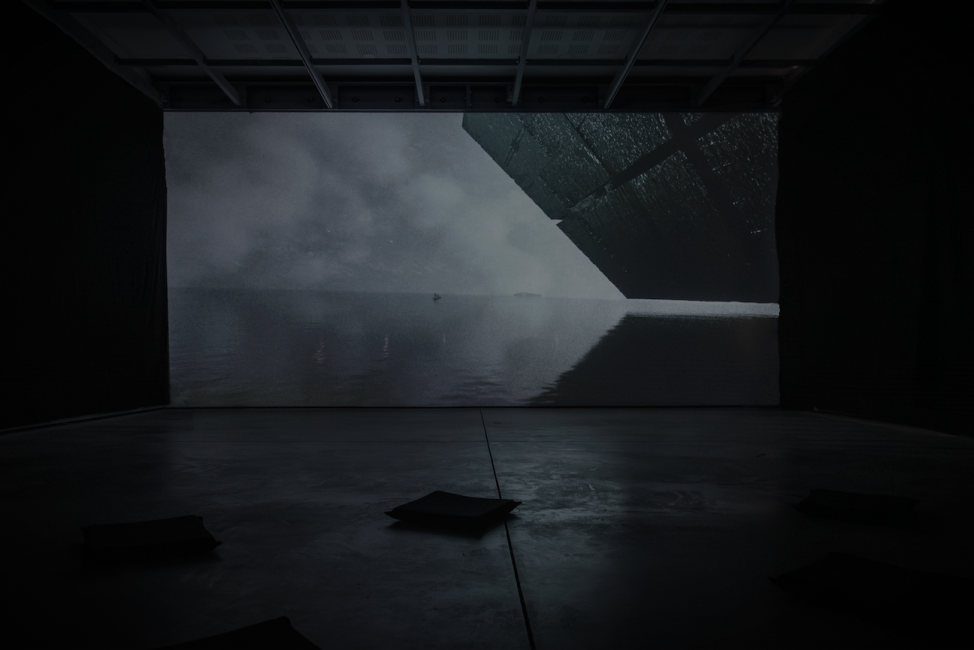
(1) In the muffled, almost primordial darkness of a cavernous space, a deep tremor begins, a silence so intense it vibrates. This is not the seismic shifting of tectonic plates but the low, insistent hum of a subterranean sonic landscape emerging from the invisible. Wisps of fog cling to unseen contours, and the soft, unsettling movement of water over an indistinct surface reflects nothing but the weight of darkness. A meticulously constructed non-site (after Robert Smithson), where the eye strains to locate form. (2) Further down a corridor, a door opens onto an inverted illuminated dome, a hollow eggshell, a dream machine, or a nurturing womb, referencing the biological architecture of the C. elegans worm, a microscopic creature whose nervous system has been mapped neuron by neuron. (3) The rotor installed in the window beside the door operates from the raw, chaotic input of quantum noise, translated into tactile frequencies that reverberate throughout the environment. It operates as a form of cybernetics, a feedback loop between the fundamental substance of the universe and its aesthetic manifestation.
Ultimately, Anathema does not merely depict mystery; it stages a passage through the House of Leaves, a space that is fluid, ungovernable, and resistant to static interpretation. Doubt, noise, and randomness are not obstacles but the very engines of its “metabolism” and the core of its aesthetic experience.